
Models of Reading

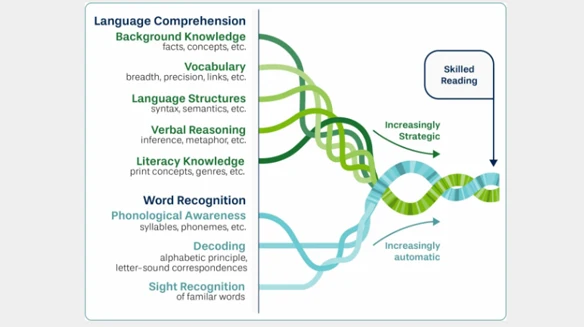
Research has identified core components that contribute to skilled reading. Conceptual models such as the Simple View of Reading (SVR) and Scarborough’s Reading Rope provide research-based frameworks for understanding how word recognition and language comprehension work together to support reading development. These models offer a foundation for exploring additional resources in this section.
The Simple View of Reading (SVR)
Scarborough’s Reading Rope
The Reading is Language Model
This introduces the Reading is Language (RIL) model, a theoretical framework developed by OxEd & Assessment that emphasizes oral language as the fundamental building block for all literacy skills. The model argues that early language proficiency is the primary predictor of later success in both word decoding and reading comprehension, advocating for early assessment and targeted intervention to improve long-term educational outcomes.
The Science of Reading Progresses

This article highlights key developments in reading science that build on the Simple View of Reading, emphasizing the additional cognitive and linguistic factors that contribute to successful reading.
Hoover & Tunmer’s Response

Provides a comprehensive, evidence-based roadmap of how children transform from beginning readers into experts. The authors argue for a “balanced and developmentally informed” approach that reconciles long-standing debates by explaining why systematic phonics is essential for “cracking the code,” while also detailing how advanced fluency and deep comprehension require a rich foundation of language, vocabulary, and background knowledge.
Kim’s DIER Model

This argues that while the Simple View of Reading is a useful starting point, it is insufficient for modern instruction because it overlooks the complex, overlapping roles of executive function, self-regulation, and morphological awareness. The authors propose the Active View of Reading model, which provides a more comprehensive framework for educators by mapping out the specific, “active” processes that bridge the gap between basic word recognition and deep language comprehension.